Capabilities Overview
- Plasma: Inductively coupled, capacitively coupled, DC and microwave plasma modeling.
- Electromagnetics: Power delivery, impedance matching, RF-plasma interactions. All frequencies.
- Heat Transfer and Structural Mechanics: Chamber & wafer-level thermal uniformity, packaging & thermal stress.
- Multiphysics Coupling: Plasma + CFD + heat transfer + electromagnetics for realistic process simulation.
- AI & Surrogate Modeling: Fast neural-net surrogates & custom apps for real-time optimization.
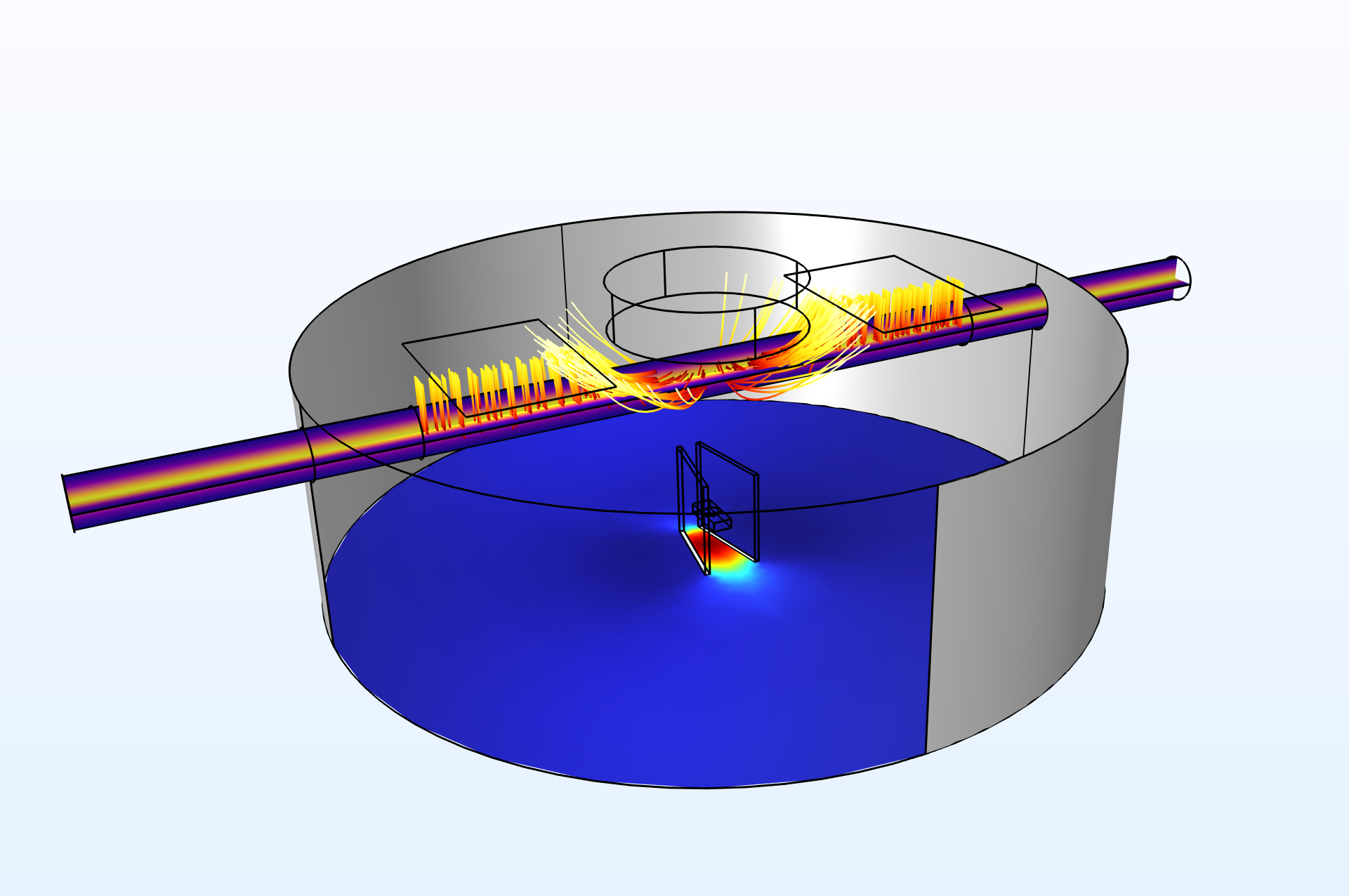
Above: Laser Isotope Separation: Orthogonal laser–beam interaction minimizes Doppler broadening and enables isotope-selective excitation and ionization.
- Plasma modeling: Plasma modeling in 1D/2D and 3D of reactors using all frequencies (DC up to GHz) for different process gases.
- Pressure range: The pressure range depends on physical size and gas complexity (lower pressures are easier than higher pressures).
- Surface chemistry: Surface chemistry and ion energy distribution computation.
- Chemical mechanism development: Chemical mechanism development.
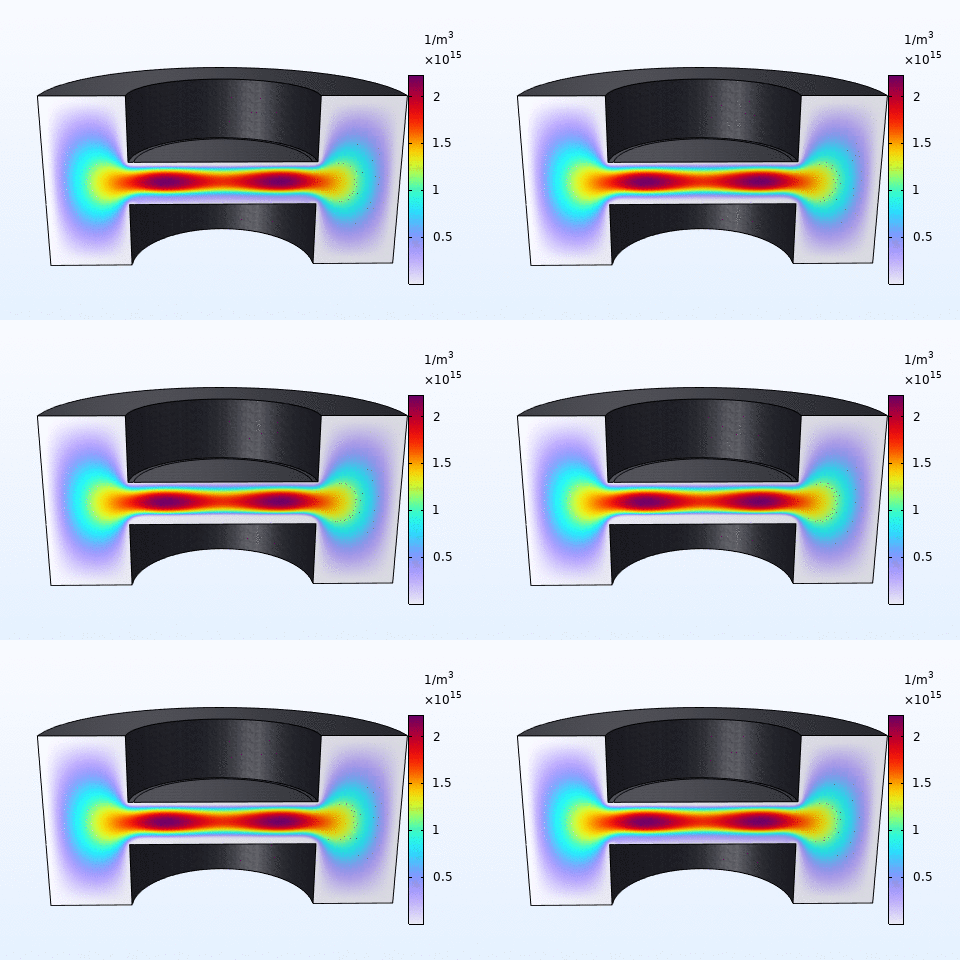
Animation: Electron Density in a capacitively coupled plasma: The electron density oscillates in the plasma sheath region close to the grounded top electrode and driven electrode on the base.
- Molecular flow: The idea to create the Molecular Flow Module at COMSOL came from my frustration with the lack of design tools available for vacuum systems during my time at MKS Instruments.
- Fluid modeling: Delivery of gases and process control (multiple patents on flow control and verification).
- RF power delivery: Extensive experience with the interaction between power supplies and plasma chambers.
- Heat transfer: Conduction, convection and radiation. Use of thermal measurements in real-time systems.
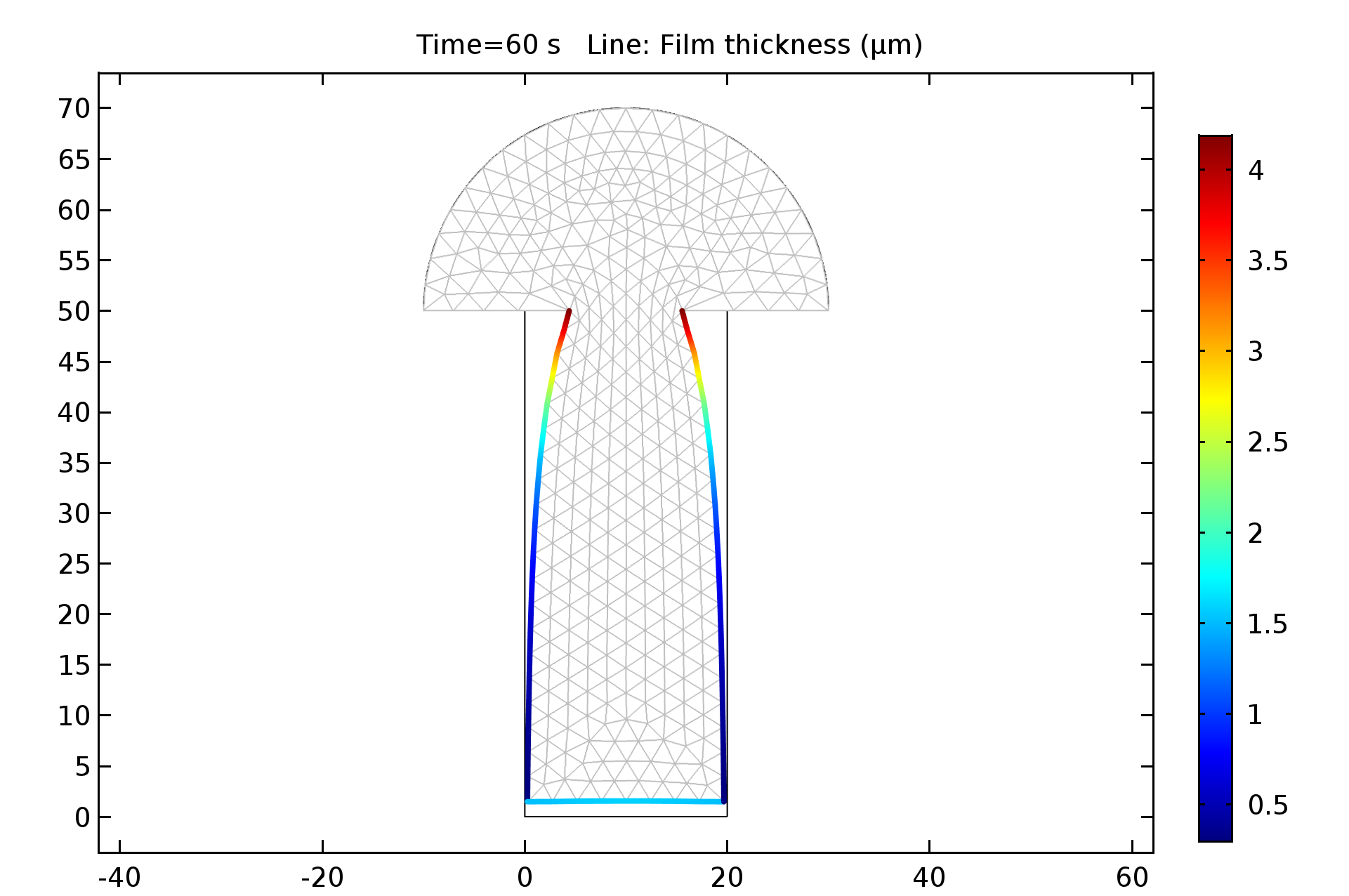
Free Molecular Flow: View-factor–dominated transport with minimal intermolecular collisions; wall processes control throughput and deposition.
App Development
- Any COMSOL model: Any COMSOL model can be compiled into an executable file and run without a license.
- Model complexity: Model complexity is shielded from the end user. Simply change a set of input parameters and compute the solution.
- Report generation: Report generation can be included.
- Apps: Apps can act as an easy-to-use digital twin. Non-experts can use them to study the system’s behavior.
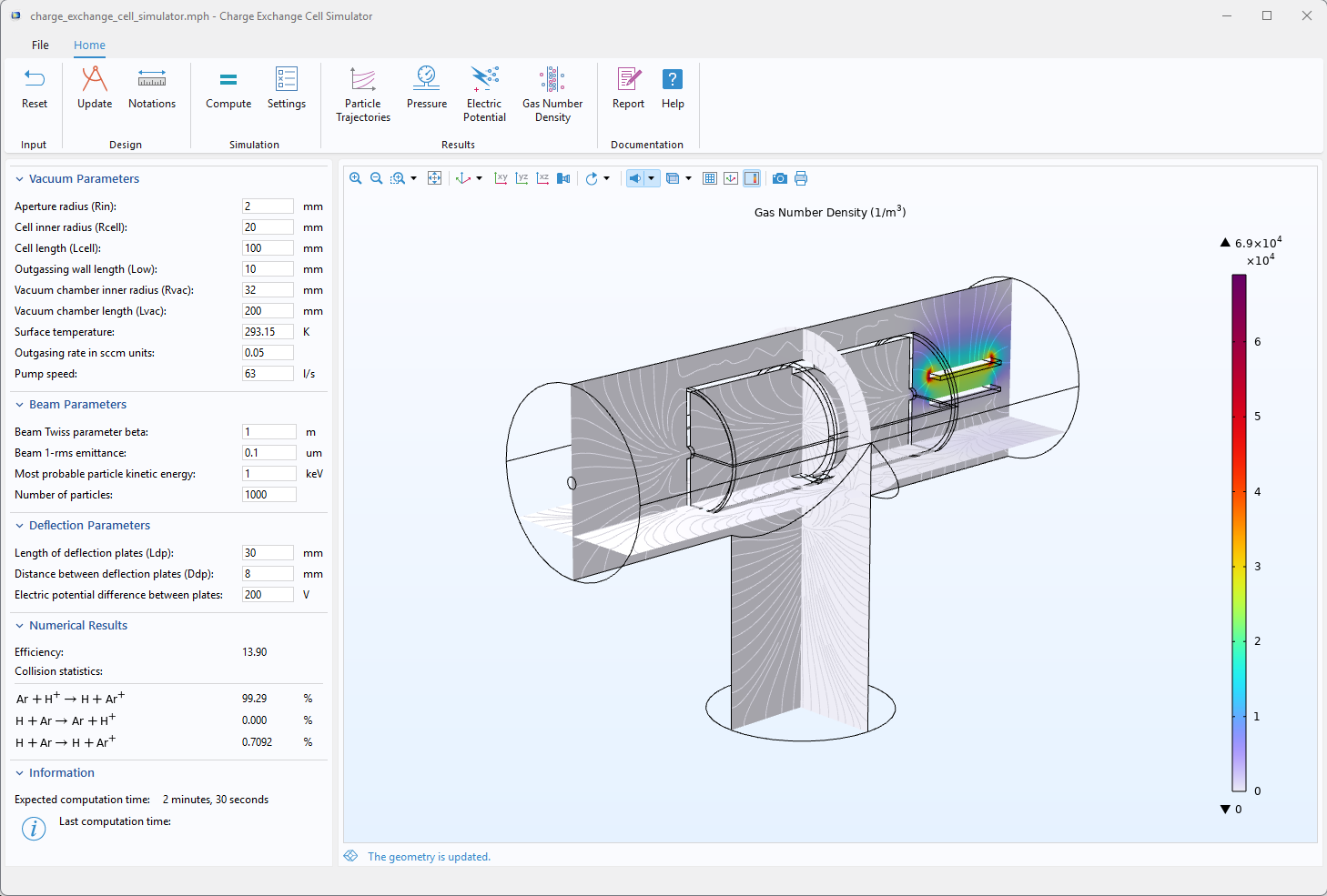
Custom app of a charge exchange cell, which couples molecular flow, electrostatics and particle tracing. The app can be run without any expertise in the COMSOL desktop environment
- Surrogate models: Models with complex response surfaces can be optimized using surrogate models.
- Training data: A large amount of training data is generated with a batch run of 3D electromagnetic simulations and subsequently used to train a neural network.
- The neural network: The neural network can evaluate designs in milliseconds, rather than minutes or hours. The sliders in the app (shown to the right) change the geometric dimensions of the antenna in real-time and update the S-parameters.
- Optimization: Optimization using only inference of the neural network is possible, allowing different objective functions to be tested rapidly.
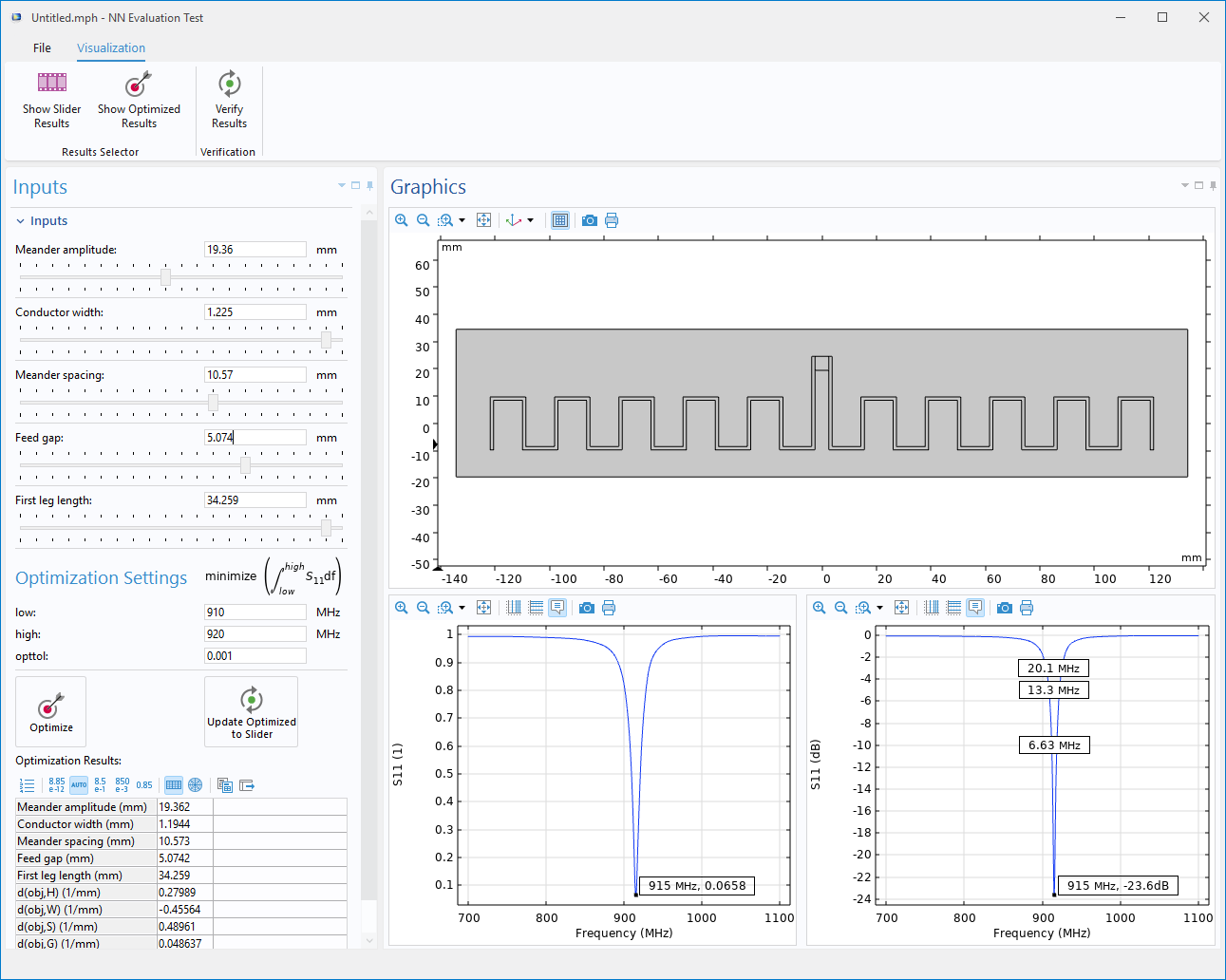
RFID tag design app which runs purely on inference, meaning designs can be studied in real-time
- Training neural networks: Training neural networks using a combination of synthetic and experimental data for deployment in an embedded system.
- Pre-trained systems: Pre-trained systems (if the simulation and/or experiments are a perfect digital twin, and environmental conditions remain the same), or real-time retraining (periodic retraining of the system every few seconds based on new experimental data. Requires a lightweight training data set).
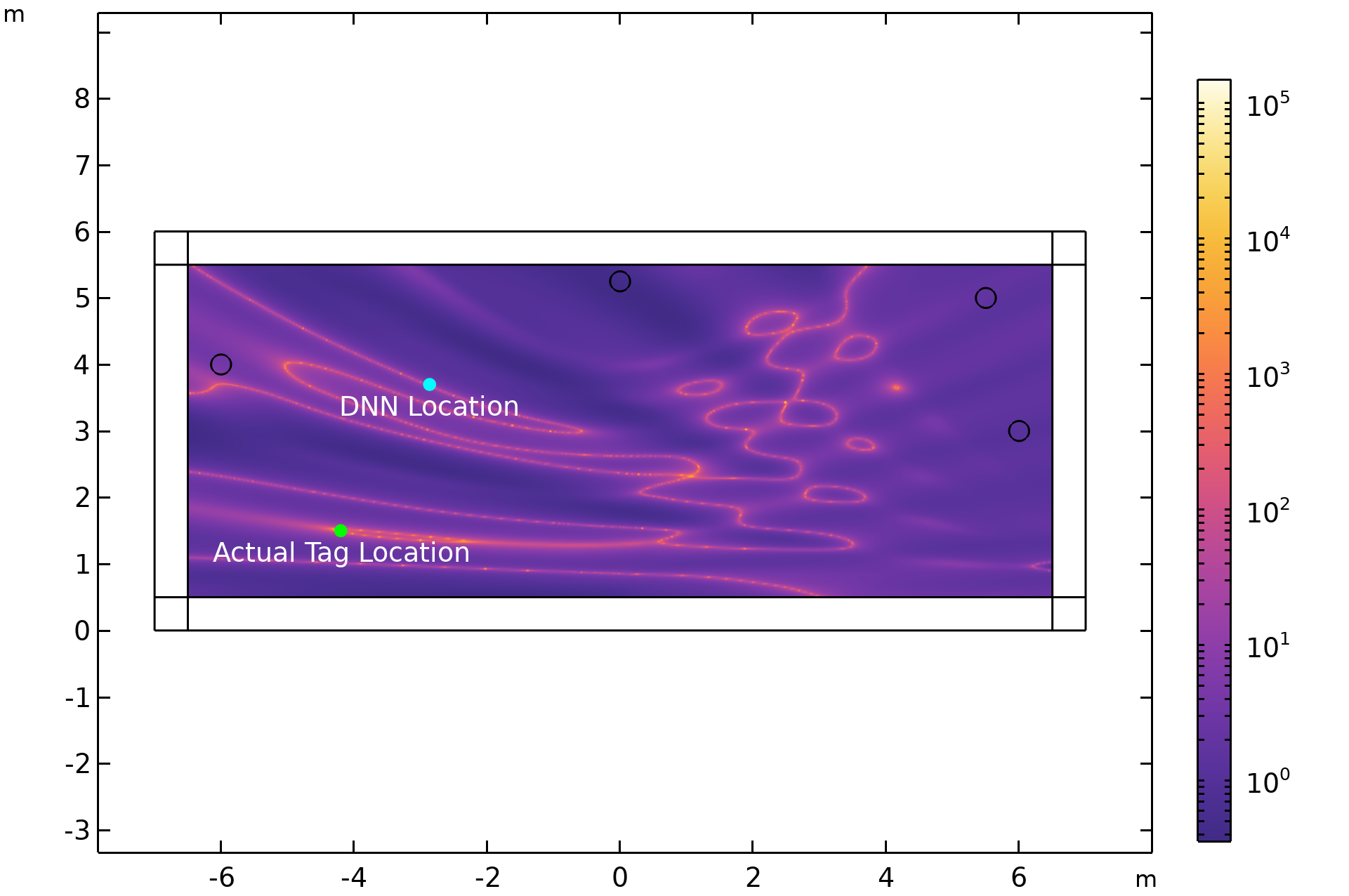
Unknown object localization “heat maps” computed on-the-fly using batch inference of a trained neural network. The NN can evaluate thousands of inference cases in a fraction of a second.
